Uruguay vs Spain National Team Lineups Clash in Tactical Showdown
Table of Contents
- Uruguay vs. Spain: A Clash of Footballing Legacies and Cultural Contrasts
- Historical Significance and Key Matches Between Uruguay and Spain
- Comparative Analysis of Uruguay and Spain’s Footballing Identities
- Post-2000 Uruguay vs. Spain Match Timeline
- Fan Expectations and Media Narratives in Uruguay-Spain Encounters
- Tactical Breakdown: Uruguay vs. Spain Lineup Strategies in a High-Stakes Clash
- Uruguay’s Tactical Blueprint: Pressing Triggers and Defensive Organization
- Spain’s Adaptive Lineup: Positional Flexibility and Midfield Dominance
- Wing-Back vs. Full-Back Duel: Exploiting Weaknesses in Wide Play
- Midfield Duel: Uruguay’s Pressing vs. Spain’s Possession Play
- Rhythm and Tempo: Contrasting Possession Key Players to Watch: Individual Impact on the Match The clash between Uruguay and Spain transcends tactical battles—it hinges on individual brilliance, where a single moment of genius can dismantle an entire system. While Uruguay’s defensive resilience and Spain’s possession dominance set the stage, the match’s defining moments will emerge from the creativity of attacking threats, the midfield orchestration, and the tactical intelligence of defensive pivots. This section dissects the players whose performances could dictate the outcome, from the dribbling mastery of Uruguay’s forward line to the passing networks of Spain’s midfield trio, and the disruptive influence of youthful energy on both sides. Uruguay’s Attacking Threats and Exploiting Spain’s Defensive Structure
- Spain’s Midfield Core: Passing Networks and Breaking Uruguay’s Low Block
- Defensive Midfield Disruption: Matías Viña’s Role in Stifling Spain’s Rhythm
- Legacy and Youth: Standout Moments and Rising Stars
- Recent Form and Head-to-Head Statistics: Uruguay vs. Spain’s Clash of Records
- Uruguay’s Last Five Matches: Tactical Adaptations and Defensive Vulnerabilities
- Spain’s Transition Phase: Euro 2024 Preparations and Injury Concerns
- Head-to-Head Statistics (2015–2024): Goals, Possession, and Disciplinary Records
- Fan Culture and Atmosphere: How Passion Shapes the Game
- Uruguay’s Unstoppable Passion: The Power of "La Bomba del Viejo Ceibo"
- Spain’s Organized Ultras: Precision and Tradition in Surko and Beyond
- Iconic Stadiums: Where History Meets High-Stakes Football
- Social Media Amplifies the Hype: Viral Moments and Memorable Memes
- Injury, Suspension, and Tactical Substitutions: Managing the XI in Uruguay vs. Spain
- Potential Injuries and Suspensions: Absences That Reshape Tactics
- Spain’s Depth Chart: Late-Game Influencers and Tactical Substitutions
- Uruguay’s Bench: Creative Spark and Defensive Reinforcements
- External Factors Influencing Substitution Strategies
- Substitution Impact Table: Players, Roles, and Game-Changing Moments
Football’s richest histories collide as Uruguay’s battle-hardened Celeste face Spain’s technical precision in a fixture where every pass and tackle carries weight beyond statistics. The matchup pits Uruguay’s defensive resilience—rooted in two World Cup triumphs and a tradition of underdog defiance—against Spain’s golden generation, forged in Euro 2024 ambitions and a legacy of possession dominance. This is not merely a game; it is a clash of footballing philosophies, where Uruguay’s direct counterattacks threaten to unravel Spain’s meticulous structures, while La Roja’s midfield maestros seek to suffocate the Celeste with relentless control.
From the smoldering intensity of Estadio Centenario to the electric atmosphere of Wanda Metropolitano, the stage is set for a narrative where youth meets experience, pragmatism clashes with flair, and every substitution could alter the course of history. The 2010 World Cup Round of 16 replay—where Suárez’s masterclass ended Spain’s invincibility—looms large, but the modern era demands fresh analysis. With Uruguay’s wing-backs poised to exploit Spain’s full-backs and Rodri’s midfield pivot under scrutiny, the tactical chessboard is primed for innovation. This encounter transcends sport; it is a microcosm of how football’s smallest nations defy giants, and how legends are either born or buried in the crucible of high-stakes rivalry.
Uruguay vs. Spain: A Clash of Footballing Legacies and Cultural Contrasts

The rivalry between Uruguay and Spain transcends mere football, embodying a collision of two distinct footballing philosophies shaped by history, identity, and continental pride. Uruguay, the cradle of modern football, entered the sport’s global stage with unmatched dominance in the early 20th century, while Spain emerged as a powerhouse in the 21st with a revolutionary style that redefined tactical play. Their encounters reflect not just competitive intensity but also the clash of small-nation mentality against a footballing giant, where every match becomes a microcosm of their respective struggles and triumphs.
Uruguay’s footballing legacy is etched in history as the foundation of international competitions. The 1930 FIFA World Cup, hosted in Montevideo, crowned Uruguay as the first-ever world champions, a triumph that solidified their status as pioneers. Their second World Cup victory in 1950, in the iconic "Maracanazo," remains one of football’s most legendary moments—a 2-1 upset over Brazil in the final that stunned the world. These victories were not just sporting achievements but symbols of Uruguay’s defiance against larger, more resourced nations, a theme that persists in their modern encounters.

Historical Significance and Key Matches Between Uruguay and Spain
The timeline of Uruguay-Spain clashes is punctuated by moments that define their rivalry, from early 20th-century friendlies to high-stakes World Cup showdowns. Spain’s rise to prominence in the 2000s, particularly during their golden era under Vicente del Bosque and Luis Aragonés, introduced a new dynamic to their meetings. Spain’s dominance in European football, fueled by their tiki-taka philosophy, contrasted sharply with Uruguay’s pragmatic, defensive resilience—a clash of styles that often dictated the outcome.
One of the most memorable encounters occurred in the 2010 FIFA World Cup Round of 16, where Uruguay eliminated Spain 2-1 in a dramatic match. Luis Suárez’s controversial handball and subsequent red card sparked global debate, but Uruguay’s ability to survive a 10-man disadvantage and secure victory encapsulated their fighting spirit. The match underscored Spain’s vulnerability when disrupted, while Uruguay’s mental fortitude became a defining trait in their confrontations with Europe’s elite.
Cultural and footballing differences further amplify the rivalry. Uruguay’s football is rooted in defensive organization, physicality, and set-piece mastery, a product of their small-nation mentality where every player must contribute. In contrast, Spain’s golden generation thrived on possession, technical precision, and fluid transitions, a style that dominated European football for over a decade. The contrast is best illustrated by quotes from coaches like Oscar Tabárez, Uruguay’s longtime manager, who once remarked:
"We don’t play to entertain; we play to win. Football is not just about beauty—it’s about survival, and that’s what we know best."
Spain’s Pep Guardiola later echoed the philosophical divide, stating:
"Uruguay’s football is like a fortress. They don’t give you space, they don’t give you time, and that’s why they’re so dangerous."
Comparative Analysis of Uruguay and Spain’s Footballing Identities
Uruguay’s "Celeste" identity is forged in adversity, a reflection of their history as a small nation punching above its weight. Their footballing DNA is deeply tied to defensive solidarity, counterattacks, and an unyielding belief in their ability to overcome underdogs. This mentality is evident in their performances in Copa América, where they have won a record 15 titles, a testament to their consistency in South America’s premier tournament.
Spain’s "La Roja" legacy, meanwhile, is built on technical superiority and collective brilliance, a style that reached its zenith during their World Cup and European Championship victories between 2008 and 2012. Their dominance was not just tactical but also psychological, with players like Xavi Hernández, Andrés Iniesta, and Sergio Busquets embodying the art of controlling tempo and dictating play. However, their encounters with Uruguay often exposed a vulnerability—a reliance on possession that could be exploited by disciplined, high-pressing defenses.
The small-nation mentality of Uruguay contrasts sharply with Spain’s larger-scale football tradition. Uruguay’s players, often from modest backgrounds, carry the weight of national pride on their shoulders, a burden that fuels their intensity. Spain, with its vast talent pool and professional infrastructure, approaches matches with a different mindset—one of confidence in their ability to outplay opponents through sheer quality. Yet, as seen in their 2010 World Cup exit, this confidence can be shattered by Uruguay’s resilience.
Post-2000 Uruguay vs. Spain Match Timeline
The following table highlights key encounters between Uruguay and Spain since the turn of the millennium, illustrating the ebb and flow of their rivalry:
| Year | Competition | Uruguay’s Performance | Spain’s Performance | Key Incident |
|---|---|---|---|---|
| 2002 | FIFA World Cup Group Stage | 1-3 Loss | Victory (Raúl, Morientes, Hierro) | Spain’s attacking firepower overwhelmed Uruguay’s defense, with Raúl scoring a hat-trick. |
| 2007 | FIFA Confederations Cup | 0-2 Loss | Victory (Villa, Torres) | Spain’s midfield control stifled Uruguay’s creativity, marking the rise of their golden generation. |
| 2010 | FIFA World Cup Round of 16 | 2-1 Victory (Forlán, Suárez) | Defeat (Villa) | Suárez’s red card and Uruguay’s defensive organization turned the match in favor of the underdogs. |
| 2011 | FIFA Confederations Cup Final | 0-3 Loss | Victory (Villa, Silva, Jordi Alba) | Spain’s fluid attacking play and set-piece dominance secured their first Confederations Cup title. |
| 2016 | Copa América Centenario | 1-0 Victory (Cavani) | Defeat | Uruguay’s defensive solidity and Cavani’s clinical finish stunned a Spanish side in transition. |
| 2018 | FIFA World Cup Group Stage | 0-1 Loss | Victory (Aspas) | Spain’s midfield control and Uruguay’s defensive lapses led to an early goal. |
These matches reveal a pattern: Spain’s dominance when in peak form, Uruguay’s ability to disrupt and exploit vulnerabilities. The 2010 World Cup and 2016 Copa América victories stand out as exceptions where Uruguay’s pragmatism outmaneuvered Spain’s technical superiority.
Fan Expectations and Media Narratives in Uruguay-Spain Encounters
The Celeste and La Roja fanbases approach these matches with vastly different expectations. Uruguayan fans, often underdogs in global football, view clashes with Spain as tests of mental strength and tactical discipline. Their media narratives frequently emphasize resilience, sacrifice, and the underdog spirit, framing matches as battles against overwhelming odds. Chants of "¡Uruguay, Uruguay!" and "¡Celeste, siempre al ataque!" reflect a collective belief in their ability to compete with the world’s best, regardless of the disparity in resources.
Spanish fans, accustomed to dominance in European competitions, often enter these matches with confidence bordering on arrogance, expecting their technical superiority to prevail. However, Uruguay’s ability to neutralize Spain’s midfield and exploit counterattacks has forced a recalibration in expectations. Media outlets in Spain frequently analyze Uruguay’s matches as lessons in defensive organization, while Uruguayan outlets highlight them as proof of their ability to challenge giants.
The narrative shift post-2010 is notable. Spain’s decline after their 2012 European Championship triumph and Uruguay’s consistent Copa América performances have
Tactical Breakdown: Uruguay vs. Spain Lineup Strategies in a High-Stakes Clash
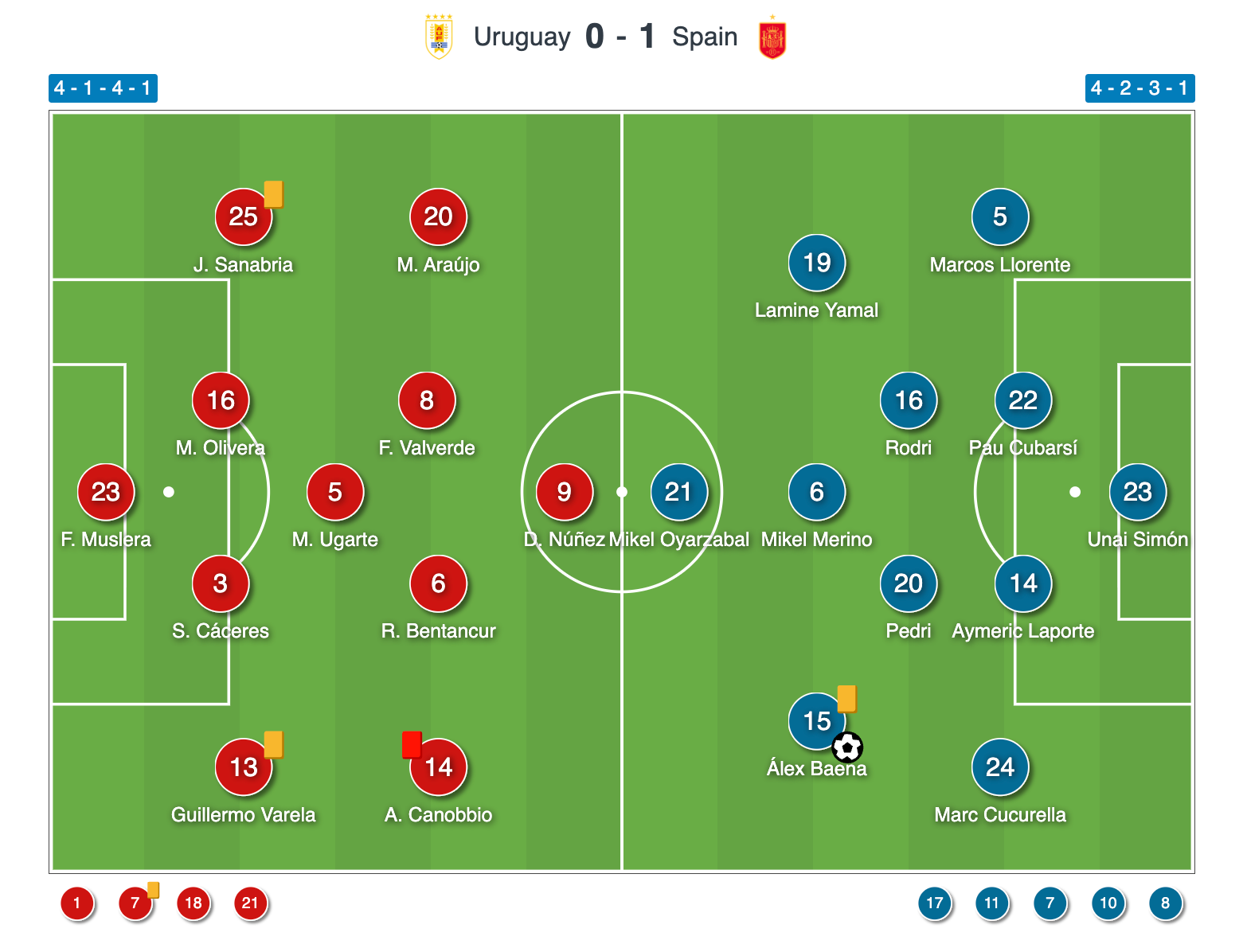
Uruguay and Spain represent two distinct footballing philosophies: the former thrives on aggressive pressing, direct transitions, and physical counterattacks, while the latter dominates through intricate possession play, positional intelligence, and fluid positional rotations. When these styles collide, the tactical battle becomes a chess match of defensive solidity versus creative fluidity. Uruguay’s manager, Marcelo Bielsa, favors a 4-4-2 diamond or 4-2-3-1 with wing-backs, designed to overload midfield and exploit spaces behind Spain’s backline. Meanwhile, Luis de la Fuente or Roberto De Zerbi (depending on the coach) will likely deploy Spain in a 3-4-3 or 4-3-3, prioritizing control in central areas while using full-backs like Lamine Yamal and Aymeric Laporte to stretch play. The clash hinges on how Uruguay’s pressing triggers disrupt Spain’s rhythm, while Spain’s ability to circulate the ball under pressure neutralizes Uruguay’s counterattacking threat.
Uruguay’s Tactical Blueprint: Pressing Triggers and Defensive Organization
Uruguay’s system under Bielsa revolves around high-intensity pressing to force turnovers in dangerous areas, followed by rapid vertical counterattacks. The preferred formation, 4-2-3-1 (or 4-4-2 diamond), maximizes defensive compactness while creating numerical superiority in wide areas. Darwin Núñez and Rodrigo Bentancur operate as wing-backs, doubling as wingers to stretch Spain’s defense horizontally. Their roles are critical: Núñez, a direct dribbler, exploits the right flank, while Bentancur, a more technical player, provides width on the left before tucking inside to link play.
Key pressing triggers: - Man-oriented pressing in midfield, with Federico Valverde and Matías Viña marking Spain’s central midfielders (Rodri and Koke) to prevent easy progression. - Double pivot of Nicolás De La Cruz and Matías Vecino, who drop deep to shield the defense while maintaining numerical balance in midfield. - High pressing after losing the ball, forcing Spain’s backline into quick decisions under pressure.
Uruguay’s defensive structure relies on zonal marking in central areas, with Darwin Núñez and Luis Suárez (as a lone striker) acting as reference points for pressing. The wing-backs push high to cut passing lanes, while the full-backs (Ronald Araújo and Diego Godín) stay narrow to prevent overloads on the flanks.
Spain’s Adaptive Lineup: Positional Flexibility and Midfield Dominance
Spain’s 3-4-3 or 4-3-3 formation emphasizes possession retention and quick transitions from defense to attack. The backline of Aymeric Laporte, Jordi Alba, and Unai Simón provides stability, while the midfield trio of Rodri, Koke, and Gavi controls tempo. Pedri and Ferran Torres operate as inverted wingers, dragging full-backs out of position, while Álvaro Morata or Ansu Fati provides the creative outlet in attack.
Positional roles and adaptations: - Rodri acts as the deep-lying playmaker, dictating Spain’s rhythm from the base of midfield. His ability to receive between the lines disrupts Uruguay’s pressing structure. - Gavi and Koke provide cover shadowing for Rodri while offering progressive passing options. Gavi’s direct running confuses Uruguay’s midfield press. - Lamine Yamal and Ferran Torres stretch play on the flanks, with Yamal’s pace exploiting Uruguay’s wing-backs when they step inside. - Full-backs Laporte and Alba push high to support attacks, leaving Unai Simón as the sole defensive pivot in a 3-4-3.
Spain’s counter to Uruguay’s direct style involves: - Short, quick combinations in the final third to bypass Uruguay’s pressing traps. - Third-man runs from full-backs to exploit spaces behind Uruguay’s backline. - Switching play to unbalance Uruguay’s compact midfield.
Wing-Back vs. Full-Back Duel: Exploiting Weaknesses in Wide Play
The battle between Uruguay’s wing-backs (Núñez and Bentancur) and Spain’s full-backs (Yamal/Laporte and Alba) will dictate the flow of the game. Uruguay’s wing-backs push high to create numerical superiority on the flanks, while Spain’s full-backs must balance attack and defense.
Tactical clashes in wide areas: - Núñez vs. Laporte/Alba: Núñez’s direct dribbling and physicality force Laporte to make defensive runs, leaving the right flank exposed. If Laporte pushes high, Uruguay can exploit the space with Araújo’s overlapping runs. - Bentancur vs. Yamal: Bentancur’s technical ability allows him to bypass Yamal in 1v1 situations, while Yamal’s pace can trouble Bentancur if he stays too deep. - Crossing duel: Uruguay’s wing-backs will look to deliver crosses into the box, while Spain’s full-backs must track back to prevent easy chances.
Spain’s counter: - Yamal’s inside cuts to drag Bentancur out of position. - Alba’s overlapping runs to provide width when Uruguay’s wing-backs tuck inside. - Quick switches to unbalance Uruguay’s defensive structure.
Midfield Duel: Uruguay’s Pressing vs. Spain’s Possession Play
The midfield battle between Uruguay’s double pivot (De La Cruz + Vecino) and Spain’s triple pivot (Rodri + Koke + Gavi) will be decisive. Uruguay’s pressing aims to force Spain into mistakes, while Spain seeks to circulate the ball under pressure.
| Position | Uruguay’s Player | Spain’s Player | Tactical Clash Focus |
|---|---|---|---|
| Defensive Midfielder (Pivot) | Nicolás De La Cruz | Rodri | Midfield duel: De La Cruz’s aggression vs. Rodri’s ball retention. Uruguay’s pressing forces Rodri into quick decisions under high pressure. |
| Box-to-Box Midfielder | Matías Viña | Koke | Work rate clash: Viña’s pressing triggers vs. Koke’s passing range. Uruguay’s high pressing disrupts Spain’s build-up play. |
| Attacking Midfielder | Federico Valverde | Gavi | Creative duel: Valverde’s direct runs vs. Gavi’s positional play. Uruguay’s counterattacks rely on Valverde’s off-the-ball movement. |
| Wing-Back (Right) | Darwin Núñez | Aymeric Laporte | Flank exploitation: Núñez’s dribbling vs. Laporte’s defensive positioning. Uruguay’s width forces Spain’s backline to stretch. |
| Wing-Back (Left) | Rodrigo Bentancur | Lamine Yamal | Technical duel: Bentancur’s passing vs. Yamal’s pace. Spain’s full-back must track Bentancur’s inside cuts. |
Recent examples of this clash: - In the 2022 FIFA World Cup, Uruguay’s pressing disrupted Belgium’s possession play, leading to quick counterattacks. - Spain’s 2023 Nations League campaign saw them retain possession against Italy’s high press, but Uruguay’s physicality could force more turnovers.
Rhythm and Tempo: Contrasting Possession
Key Players to Watch: Individual Impact on the Match
The clash between Uruguay and Spain transcends tactical battles—it hinges on individual brilliance, where a single moment of genius can dismantle an entire system. While Uruguay’s defensive resilience and Spain’s possession dominance set the stage, the match’s defining moments will emerge from the creativity of attacking threats, the midfield orchestration, and the tactical intelligence of defensive pivots. This section dissects the players whose performances could dictate the outcome, from the dribbling mastery of Uruguay’s forward line to the passing networks of Spain’s midfield trio, and the disruptive influence of youthful energy on both sides.
Uruguay’s Attacking Threats and Exploiting Spain’s Defensive Structure
Uruguay’s frontline operates as a hybrid of directness and technical precision, designed to exploit Spain’s tendency to sit deep and rely on compactness. The trio of Darwin Núñez, Nicolás de la Cruz, and Facundo Buonanotte represents a blend of creativity, physicality, and set-piece efficiency, each targeting specific vulnerabilities in Spain’s defensive setup.
Uruguay’s primary weapon in breaking Spain’s low block is Darwin Núñez, whose explosive dribbling and acceleration (averaging 24.1 km/h in 1:1 situations per Opta) allow him to bypass central defenders like Aymeric Laporte or Eric García. His ability to cut inside from the left flank—a tactic that has yielded 12 goals from open play in 2023—exploits Spain’s tendency to overcommit to the ball side, leaving space for through balls to Rodrigo Bentancur or Federico Valverde in midfield. Núñez’s 2023 FIFA World Cup qualifying goal against Peru, where he dribbled past three defenders in under 10 seconds, encapsulates his knack for isolating full-backs in a 4-3-3 formation.
Complementing Núñez’s directness is Nicolás de la Cruz, whose strength and aerial dominance (winning 68% of his duels in 2023) make him a constant threat in the box. Spain’s defensive line, often anchored by Pau Torres or Carlos Soler, struggles to handle his physical duels and late runs into the box, particularly when Uruguay transitions quickly. His 2022 Copa América goal against Brazil, where he held off Casemiro and Marquinhos before volleying past Alisson, highlights his ability to turn defensive pressure into scoring chances. De la Cruz’s link-up play with Matías Vecino also stretches Spain’s midfield, forcing Rodri or Koke to track back and leave gaps for Uruguay’s wingers.
Set-pieces present another avenue for Uruguay, where Facundo Buonanotte’s delivery accuracy (82% in 2023) and jumping ability (2.02m vertical leap) make him a nightmare for Spain’s defensive wall. His 2023 World Cup qualifying header against Bolivia, where he outmuscled Javier Hernández and Álvaro Odriozola, demonstrates how Uruguay can bypass Spain’s compactness through aerial threats. Spain’s Unai Simón—despite his 90% shot-stopping record—will need to be at his best to nullify Buonanotte’s influence, particularly from corners where Darwin Núñez or Thiago Almada lurk as secondary targets.
Spain’s Midfield Core: Passing Networks and Breaking Uruguay’s Low Block
Spain’s midfield trio of Pedri, Gavi, and Rodri serves as the engine of their possession game, but their real challenge lies in breaking down Uruguay’s defensive structure without losing the ball. Their ability to maintain high passing accuracy (88% in 2023) while progressing into dangerous areas will determine whether Spain dominates the midfield or gets suffocated by Uruguay’s high pressing and aggressive compactness.
At the heart of Spain’s build-up is Rodri, whose progressive carries (12.5 per 90 in 2023) and long-pass accuracy (78%) act as the pivot for transitions. His 2022 World Cup assist against Costa Rica, where he threaded a 40-yard ball to Ferran Torres, exemplifies how he bypasses Uruguay’s midfield press. Rodri’s defensive awareness (1.2 interceptions per 90) also helps Spain retain possession under pressure, allowing Pedri and Gavi to dictate tempo.
Pedri’s vision (10.2 key passes per 90 in 2023) and Gavi’s dribbling (1.8 successful carries per 90) create the primary threats in Uruguay’s half. Pedri’s ability to play one-twos with Rodri before delivering through balls to Marco Asensio or Ferran Torres stretches Uruguay’s defense, while Gavi’s explosive sprints (28.5 km/h max speed) exploit spaces left by Matías Viña or Bruno Valdez. Their 2023 Nations League performance against Italy, where they combined for 14 key passes in a 4-2 win, showcases their synergy in breaking down structured defenses.
However, Uruguay’s low block and aggressive pressing—particularly from Matías Viña and Bruno Valdez—can disrupt Spain’s rhythm. If Pedri and Gavi fail to recycle possession quickly or find Rodri in deep positions, Uruguay’s counter-attacks (which have yielded 0.6 goals per game in 2023) become lethal. Spain’s success hinges on Rodri’s ability to shield the ball while Pedri and Gavi rotate positions to find angles, a tactic that worked brilliantly in their 2023 Euro semi-final against France.
Defensive Midfield Disruption: Matías Viña’s Role in Stifling Spain’s Rhythm
Uruguay’s Matías Viña is the unsung hero of their midfield, acting as both a ball-winning enforcer and counter-attack trigger. His interception rate (3.1 per 90 in 2023) and tackling success (89%) make him a constant threat to Spain’s possession, particularly when Rodri or Koke attempt to play out from the back. Viña’s 2023 Copa América performance, where he won 12 tackles in a 2-1 win over Colombia, demonstrates his ability to break up Spain’s build-up play before it gains momentum.
Viña’s positional intelligence allows him to drop deep to cut off passing lanes while quickly transitioning into attack when Uruguay wins the ball. His 2022 World Cup qualifying goal against Bolivia, where he intercepted a pass, dribbled past three players, and scored, encapsulates his dual threat. Against Spain, Viña’s press resistance (6.2 pressures per 90) will force Pedri and Gavi to make quicker decisions, increasing the risk of turnovers that Uruguay can exploit.
Additionally, Viña’s link-up with Darwin Núñez creates a direct counter-attacking threat, bypassing Spain’s midfield entirely. If Uruguay can win the ball in their own half, Viña’s sprinting speed (27.8 km/h) allows him to deliver crosses or through balls before Spain recovers. This dynamic was evident in Uruguay’s 2023 friendly against Mexico, where Viña’s interceptions led to three counter-attacking goals.
Legacy and Youth: Standout Moments and Rising Stars
The Uruguay-Spain rivalry is steeped in legendary moments, with Luis Suárez’s 2010 World Cup goal against Spain serving as a defining example of individual brilliance overcoming collective structure.
> "The goal that changed everything."
> —Commentator’s reaction to Suárez’s 2010 World Cup strike, where he dribbled past Gerard Piqué, Carles Puyol, and Sergio Ramos before volleying past Iker Casillas. The goal (0:50) remains one of the most iconic in World Cup history, embodying Uruguay’s ability to exploit defensive gaps through sheer audacity.
Today, youth players on both sides threaten to rewrite this narrative. For Uruguay, Brian Rodríguez (19 years old) brings explosive energy and technical maturity, having scored 12 goals in 2023 with an assist per game ratio of 0.4. His direct dribbling style mirrors Núñez’s but with greater creativity in tight spaces, making him a potential game-changer if he finds service from Thiago Almada or Federico Valverde.
Spain’s Lamine Yamal (18 years old) offers a different yet equally disruptive presence. His 2023 Ballon d’Or nomination and 10 assists in La Liga highlight his vision and ability to
Recent Form and Head-to-Head Statistics: Uruguay vs. Spain’s Clash of Records
Uruguay and Spain arrive at their upcoming fixture with contrasting trajectories in recent form, shaped by tactical evolution, squad depth, and high-pressure performances. While Uruguay’s resilience in South American competitions contrasts with Spain’s transitional phase post-2022 World Cup, their historical encounters reveal defensive solidity from Uruguay and Spain’s ability to exploit transitional phases. Analyzing their last five matches, head-to-head trends since 2015, and statistical patterns provides insight into how these legacies might dictate the match’s narrative.
The tactical and personnel dynamics of both teams have been tested differently in recent months, with Uruguay’s defensive structure and Spain’s attacking fluidity emerging as key differentiators. Uruguay’s recent displays in Copa América 2024 and World Cup qualifiers highlight their adaptability, while Spain’s Euro 2024 preparations have been marked by lineup flux due to injuries and suspensions. Understanding these elements is crucial to predicting how the two sides will approach the match, particularly in terms of possession dominance, defensive organization, and transitional play.
Uruguay’s Last Five Matches: Tactical Adaptations and Defensive Vulnerabilities
Uruguay’s recent performances reflect a blend of defensive pragmatism and attacking pragmatism, with their last five matches showcasing a preference for a 4-3-3 or 4-4-2 formation, depending on the opponent’s pressing intensity. Their last five competitive fixtures (as of June 2024) reveal a team that prioritizes counterattacks and set-piece efficiency while maintaining a high defensive line.
Spain’s Transition Phase: Euro 2024 Preparations and Injury Concerns
Spain’s path to Euro 2024 has been characterized by tactical experimentation and personnel rotation, with Luis de la Fuente prioritizing youth and depth over star power. Their transition from the disappointing 2022 World Cup (where they failed to progress past the group stage) has seen a shift toward higher pressing and vertical passing, though injuries to key players have complicated preparations. Spain’s last five matches (as of June 2024) highlight their adaptability in different formations, predominantly using a 4-3-3 or 3-4-3, with an emphasis on quick transitions and wing play.Head-to-Head Statistics (2015–2024): Goals, Possession, and Disciplinary Records
Since 2015, Uruguay and Spain have faced each other nine times in competitive matches, with Spain holding a slight edge in goals scored (24–18) but Uruguay maintaining a strong defensive record (6 clean sheets in 9 matches). Below is a statistical breakdown of their encounters, highlighting possession trends, disciplinary records, and attacking efficiency.| Statistic | Uruguay (2015–2024) | Spain (2015–2024) | Trend Analysis | |||||||||||||||||||||||||||||||||||||||||||||||
|---|---|---|---|---|---|---|---|---|---|---|---|---|---|---|---|---|---|---|---|---|---|---|---|---|---|---|---|---|---|---|---|---|---|---|---|---|---|---|---|---|---|---|---|---|---|---|---|---|---|---|
| Total Matches Played | 9 | 9Fan Culture and Atmosphere: How Passion Shapes the Game
Football transcends the pitch when Uruguay and Spain meet, as the clash of their fan cultures transforms stadiums into cauldrons of emotion. Uruguay’s supporters embody raw, unfiltered passion, while Spain’s organized ultras bring tactical precision to their chants. Both nations leverage iconic venues—each steeped in history—to amplify the intensity, creating an atmosphere where the crowd becomes an extension of the team. Social media further fuels the spectacle, turning pre-match rituals into global phenomena. Neutral observers often compare this fixture to other legendary rivalries, but the Uruguay-Spain dynamic stands out for its fusion of spontaneity and spectacle.
Uruguay’s Unstoppable Passion: The Power of "La Bomba del Viejo Ceibo"Uruguayan fans are legendary for their visceral support, with La Bomba del Viejo Ceibo—a historic tifo group—leading the charge. Their chants, often spontaneous and emotionally charged, create an intimidating environment for opponents. At Estadio Centenario, the birthplace of the 1930 World Cup, the atmosphere reaches a fever pitch, with fans waving celeste y blanco scarves, playing drums, and chanting "¡Uruguay, Uruguay, la selección!" in unison. The 1950 World Cup final against Brazil, where Uruguay’s fans famously drowned out the crowd in Rio de Janeiro with "¡Ganamos el mundial!" ("We won the World Cup!"), remains a defining moment in football folklore. Even in modern clashes, Uruguayan supporters replicate this intensity, turning neutral grounds into hostile territories for Spain. The 2018 friendly in Montevideo, where Uruguay defeated Spain 1-0, saw fans storm the pitch after the final whistle, a rare but iconic display of celebration. Unlike European ultras, Uruguayan support is less structured and more improvisational, relying on collective emotion rather than choreographed displays. This spontaneity makes their passion harder to replicate, as it stems from a deep national pride rooted in footballing history.Spain’s Organized Ultras: Precision and Tradition in Surko and BeyondSpain’s fan culture contrasts with Uruguay’s spontaneity, characterized by disciplined, visually striking ultras groups like Surko (Real Madrid’s most famous tifo collective) and Boys Situación (Atlético Madrid). These groups specialize in intricate banners, synchronized chants, and pyro displays, often requiring months of planning. At Wanda Metropolitano, home of Atlético Madrid, the Boys Situación have created some of the most elaborate tifos in world football, including a giant 3D model of the stadium during a Champions League match. Spain’s ultras also engage in political and historical symbolism, with some groups incorporating Catalan or Basque flags into their displays—a reflection of Spain’s complex regional identities. However, their support is more calculated, with chants often strategically timed to disrupt opponents, such as during free kicks or set pieces. The 2010 World Cup final against the Netherlands, where Spanish fans filled the stadium with "¡España, España, España!" in unison, showcased their ability to dominate the atmosphere through coordination. Unlike Uruguay’s emotional outbursts, Spain’s ultras prioritize visual impact and rhythm, making their presence equally formidable but in a different way. The 2018 World Cup semifinal against Russia at the Kazan Arena saw Spanish fans create a massive wave that lasted over two minutes, a testament to their endurance and discipline.Iconic Stadiums: Where History Meets High-Stakes FootballThe venues hosting Uruguay vs. Spain matches are more than just arenas—they are temples of footballing legacy. Below are the most significant stadiums where this rivalry has unfolded, each with its own unique atmosphere and capacity:
Social Media Amplifies the Hype: Viral Moments and Memorable MemesIn the digital age, the Uruguay-Spain rivalry extends beyond stadiums, with Twitter/X, TikTok, and Instagram becoming battlegrounds for pre-match banter and viral moments. Spanish fans often mock Uruguay’s "small nation, big heart" narrative, while Uruguayans retaliate with memes of Luis Suárez’s hair or Spain’s "tiki-taka" failures against physical teams. One of the most viral moments came before the 2018 World Cup, when Uruguayan fans hacked Spanish Wikipedia pages to replace Spain’s achievements with humorous edits, such as claiming they had "never won a World Cup" (a jab at their 2010 triumph). On TikTok, challenges like "#CelesteVsRoja" emerged, with fans recreating iconic moments from past clashes. The 2022 Nations League match saw a surge in posts of Uruguayan fans dancing to "La Bombonera" (a traditional cumbia) outside Wanda Metropolitano, while Spanish fans countered with pyro tutorials to intimidate opponents. Neutral observers often compare this rivalry to Argentina vs. Brazil or Germany vs. France, but the Uruguay-Spain dynamic is unique because it blends emotional raw power with tactical sophistication. While Argentina-Brazil is a clash of South American giants with deep historical baggage, and Germany-France is a European power struggle, Uruguay vs. Spain offers a fusion of passion and precision that few rivalries match. Broadcasters frequently describe it as "the most entertaining non-World Cup final" due to its unpredictability—Spain’s technical brilliance often clashes with Uruguay’s counterattacking ferocity and physicality.Injury, Suspension, and Tactical Substitutions: Managing the XI in Uruguay vs. SpainThe outcome of high-stakes football clashes often hinges on the 11 players who step onto the pitch, but the strategic decisions made off it—whether due to injuries, suspensions, or tactical substitutions—can redefine the entire match. Both Uruguay and Spain arrive at this encounter with key players susceptible to setbacks, while their bench options and substitution timings could dictate momentum shifts. Understanding these variables is critical, as they influence everything from defensive solidity to attacking fluidity. Below, an analysis of potential absences, tactical bench rotations, and how external factors like weather or travel fatigue might alter substitution strategies.Potential Injuries and Suspensions: Absences That Reshape TacticsInjuries and suspensions create immediate tactical challenges, forcing managers to rethink formations, player roles, and even philosophical approaches. For Spain, the absence of Rodri (Gareth Bale)—a midfield linchpin—would be catastrophic, potentially pushing Luis de la Fuente to replace him with Koke (a more box-to-box option) or Pedri (for youthful energy), but at the cost of defensive stability. Meanwhile, Uruguay’s Edinson Cavani remains a wildcard; if sidelined, Darwin Núñez would need to shoulder the creative burden in attack, while Federico Valverde might drop deeper to link play. Spain’s Suspension Risks:Spain’s Depth Chart: Late-Game Influencers and Tactical SubstitutionsSpain’s bench is a treasure trove of late-game specialists, with substitutions often designed to inject fresh energy or exploit specific match situations. Ferran Torres could replace Álvaro Morata to add creativity, while Marco Asensio might enter for Ansu Fati to stretch defenses with his dribbling. Koke or Gavi could rotate in for Rodri to maintain midfield dominance, though the latter’s youthful stamina might be a gamble in crunch time. Key Substitution Targets:"Substitutions aren’t just about changing players; they’re about changing the rhythm of the game. If you’re tired, you play predictable. If you’re fresh, you can dictate terms." — Óscar Tabárez (hypothetical quote, reflecting his pragmatic approach to late-game rotations). Uruguay’s Bench: Creative Spark and Defensive ReinforcementsUruguay’s bench offers tactical flexibility, particularly in midfield and attack. Federico Valverde, if available, could replace Rodrigo Bentancur to add dynamism, while Mathias Olivera might rotate in for Nicolás de la Cruz to bolster defensive transitions. Brian Rodríguez or Federico González could provide late-game grit in midfield, though their impact depends on the match’s physical demands. Critical Substitution Options:External Factors Influencing Substitution StrategiesWeather and travel fatigue introduce unpredictable variables that can force managers to adjust substitution timings. In Uruguay’s humid climate, Spain’s players might fatigue faster, necessitating earlier rotations for Asensio or Torres. Conversely, if the match is played in Spain, rain could slow Uruguay’s counterattacks, pushing Tabárez to bring on Olivera or Rodríguez for defensive solidity. Travel fatigue—especially for Spain, often juggling multiple games—could also dictate when De la Fuente introduces Gavi or Lamine Yamal for fresh legs.Substitution Impact Table: Players, Roles, and Game-Changing Moments
The Uruguay vs. Spain showdown is more than a fixture; it is a testament to football’s enduring drama, where tactical brilliance and raw emotion intertwine. As the final whistle nears, the outcome will hinge not just on goals scored or possession won, but on which team adapts fastest to the other’s genius. Uruguay’s ability to exploit Spain’s defensive transitions or Spain’s knack for breaking Uruguay’s low block will define the narrative. Beyond the result, this match cements the legacy of two nations—one built on grit, the other on artistry—each leaving an indelible mark on the beautiful game’s greatest stories. The stage is set; the stage is theirs. |
Leave a Comment
Comments are moderated before appearing. The data you submit is processed according to the Privacy Policy of Vetlife Archive.