SuffixWhatItMeansUnlockingWordTransformationPower
Table of Contents
- Understanding the Core Concept of Suffixes
- Fundamental Definition and Linguistic Role
- Historical Evolution of Suffixes in English
- Categorization of Suffixes: Derivational vs. Inflectional
- Common Misconceptions About Suffixes
- Semantic Shifts Through Suffixation
- Types of Suffixes and Their Grammatical Functions in Language Structure
- Classification of Suffixes by Grammatical Function
- Suffixes in Word Formation: Building New Vocabulary Through Morphological Expansion
- Process of Coinage: How Suffixes Create New Words in Modern English
- Step-by-Step Guide to Constructing Compound Words with Suffixes
- Suffixes That Create Abstract Nouns: A Table of Derivational Patterns
- Suffixes in Technical and Jargon-Heavy Fields: Specialized Suffixes in Sentence Structure and Syntax Suffixes function as silent architects of meaning within sentences, subtly shaping grammatical roles, syntactic relationships, and semantic ambiguity. Unlike prefixes that alter word roots at the beginning, suffixes modify words at their endings, often transforming verbs into nouns, adjectives into adverbs, or passive constructions into active ones. Their influence extends beyond word formation, permeating sentence syntax by dictating subject-verb-object alignment, voice distinctions, and even idiomatic phrasing. Understanding these dynamics reveals how suffixes act as grammatical pivots, enabling nuanced communication while occasionally introducing ambiguity that challenges interpretation. Suffixes and Syntactic Role Determination
- Suffix-Induced Ambiguity in Sentence Interpretation
- Active vs. Passive Voice Constructions with Suffix-Driven Syntax
- Suffixes in Idiomatic Expressions and Fixed Phrases
- Visual Mapping of Suffix-Driven Sentence Connections
- Practical Applications of Suffixes in Writing and Communication
- Checklist for Avoiding Overuse and Misapplication of Suffixes
- Professional Writing Templates Leveraging Suffixes for Precision
- Optimizing Content for SEO and Readability Through Suffixes
- 15 Suffixes for Persuasive Writing and Emotional Impact
- Fill-in-the-Blank Exercise: Matching Suffixes to Base Words
- Advanced Topics: Suffixes in Linguistics and Language Theory
- Suffixes in Morphological Typology: Agglutinative vs. Fusional Systems
- Suffix Parsing in Computational Linguistics: Stemming, Lemmatization, and NLP Challenges
- Sociolinguistic Adaptations: Suffixes as Mirrors of Cultural and Gender Shifts
- Case Study: Swedish Gender-Neutral Suffixes and Turkish Honorific Systems
- Productive vs. Unproductive Suffixes: A Comparative Analysis
Language evolves through silent architects—suffixes—those unassuming letter clusters that silently transform verbs into nouns, adjectives into adverbs, and simple words into complex ideas. From the Latin -tion shaping action to the Greek -ism birthing socialism, these grammatical appendages have quietly governed English for over a millennium, yet most speakers remain unaware of their profound influence. Every time a writer crafts unbelievable or a speaker says teacher, they are leveraging a system older than Shakespeare’s quill, one that blends precision with creativity in ways that prefixes or root words alone cannot replicate.
The journey of suffixes mirrors the story of English itself—born from Old English’s modest beginnings, reshaped by Viking invasions, refined by Norman French, and now a global toolkit for wordplay. Linguists trace their rise through key milestones: the 14th-century influx of -ness and -hood, the 18th-century adoption of -ize from Greek, and the 20th-century explosion of -ing in digital slang. Yet beneath this historical tapestry lies a paradox: suffixes are both invisible and indispensable. They slip into sentences like ghosts, altering meaning without drawing attention—until a misplaced -ed turns a clear statement into a grammatical labyrinth. This exploration dives into the mechanics, mysteries, and mastery of suffixes, revealing how they turn base words into linguistic masterpieces.
Understanding the Core Concept of Suffixes

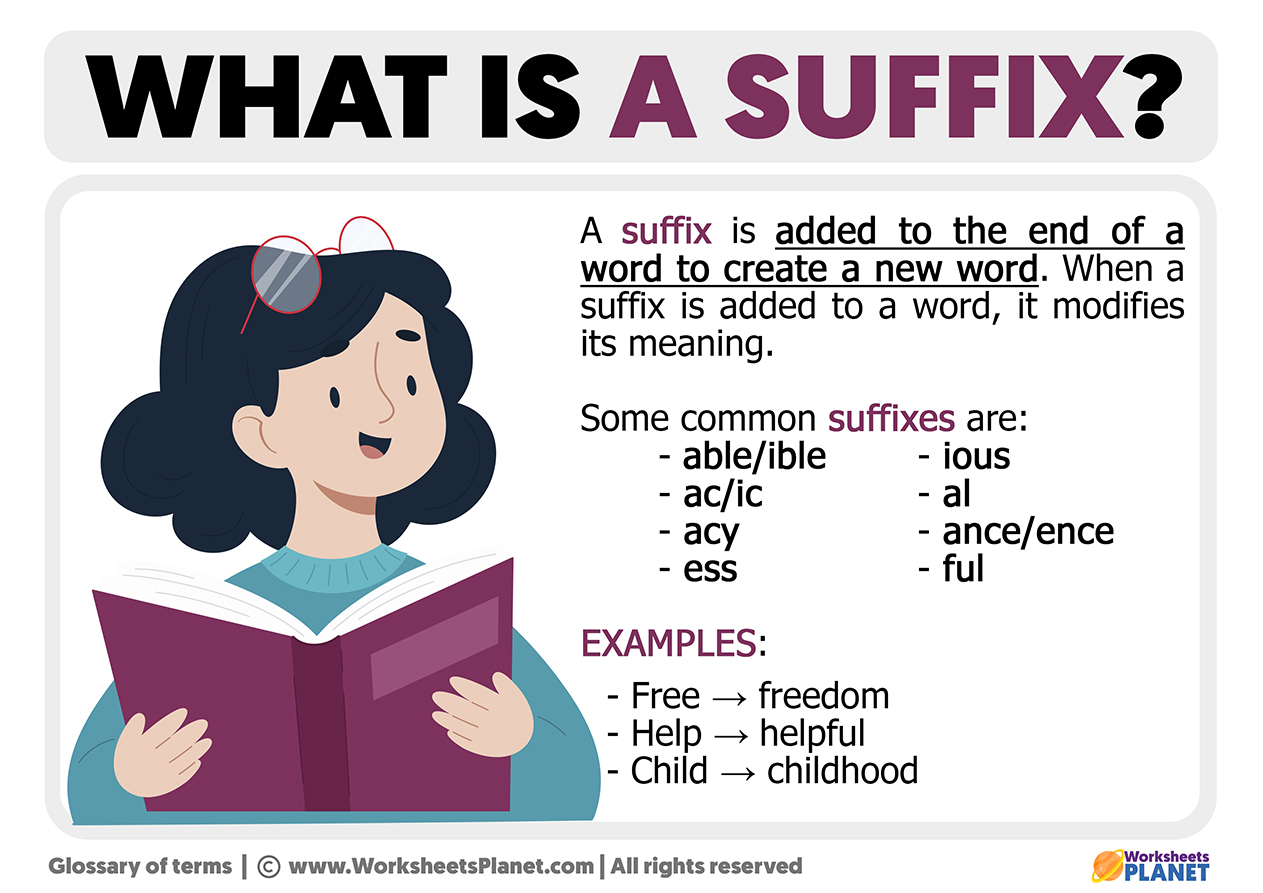
Suffixes serve as foundational building blocks in linguistics, shaping the structure and meaning of words by attaching to their roots or stems. Unlike prefixes, which precede a root to modify its meaning (e.g., un- in unhappy), suffixes follow the root, often altering grammatical function or semantic nuance. For instance, the root happy transforms into happiness when the suffix -ness is appended, shifting from an adjective to a noun while retaining a core emotional association. This distinction underscores suffixes’ role in expanding vocabulary and grammatical precision, a process deeply embedded in English’s morphological evolution.
Fundamental Definition and Linguistic Role
Suffixes are affixes that attach to the end of a word’s base form (root or stem) to create new words or modify grammatical properties. They contrast sharply with prefixes—which prepend to roots—and root words, which stand alone as independent lexical units. While prefixes like re- (as in rewrite) or dis- (as in disappear) alter meaning by negation or repetition, suffixes often serve dual purposes: derivational (changing word class) and inflectional (adjusting tense, number, or possession without altering core meaning).
For example: - Derivational suffix: teach (verb) + -er → teacher (noun). - Inflectional suffix: cat (singular) + -s → cats (plural). The distinction lies in their impact: derivational suffixes create new lexical entries, whereas inflectional suffixes adapt existing words to fit grammatical contexts.
Historical Evolution of Suffixes in English
The trajectory of suffixes in English reflects broader linguistic shifts, from Old English (450–1150 AD) to Modern English (post-1500 AD). Early Old English relied heavily on Germanic suffixes, such as -ung (e.g., singung for "singing") and -ian (e.g., cildian for "childhood"). However, the Norman Conquest (1066) introduced Latin and Greek influences, enriching English with suffixes like: - -ity (from Latin -itas), transforming pure → purity. - -logy (from Greek -logia), forming biology from bio- (life) + -logy (study).
Key milestones include: - Middle English (1100–1500): Borrowed suffixes from French (e.g., -age in marriage) and expanded noun-forming suffixes like -hood (childhood). - Early Modern English (1500–1700): Scientific and academic terms adopted Greek/Latin suffixes (e.g., -graphy in geography). - Modern English (18th century–present): Productivity of native suffixes (e.g., -ize in publicize) alongside loan suffixes (e.g., -ment in government).
This evolution demonstrates how suffixes adapt to cultural, scientific, and technological needs, cementing their role in lexical innovation.
Categorization of Suffixes: Derivational vs. Inflectional
Suffixes are broadly classified into two types, each serving distinct grammatical and semantic functions. Understanding their differences clarifies how they reshape language.
Derivational suffixes change a word’s part of speech or meaning, while inflectional suffixes modify grammatical features without altering core lexical identity.
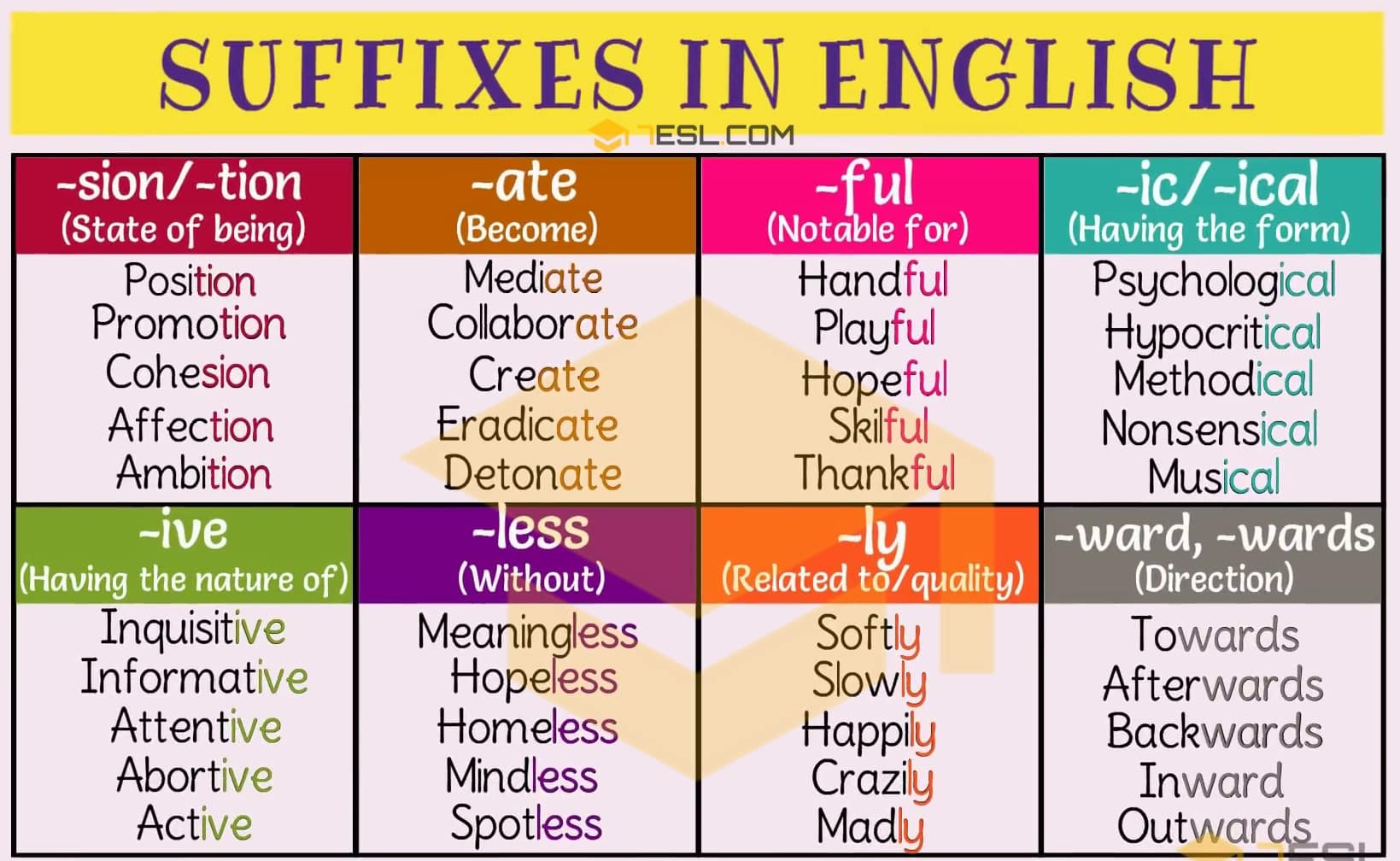
Derivational Suffixes: These suffixes transform words into new categories, often introducing nuanced meanings. Examples include: - -tion/-sion: Converts verbs to nouns (act → action, decide → decision). - -ful: Adjectival suffix (hope → hopeful). - -less: Negation (fear → fearless).
Inflectional Suffixes: These suffixes adjust words to fit grammatical structures, such as tense, number, or possession. Examples include: - -s/-es: Pluralization (dog → dogs, box → boxes). - -ed: Past tense (jump → jumped). - -’s: Possessive (child → child’s).
Comparison Table: Suffixes vs. Prefixes vs. Root Words
| Category | Definition | Function in Sentences | Examples (With/Without Modification) | Grammatical Role |
|---|---|---|---|---|
| Suffix | An affix added to the end of a root/stem to alter meaning or grammatical function. | Expands vocabulary or adjusts grammatical features. |
|
Noun-forming, adjective-forming, verb-forming, etc. |
| Prefix | An affix added to the beginning of a root to modify its meaning. | Negates, intensifies, or reverses meaning. |
|
Meaning alteration (e.g., negation, temporal shifts). |
| Root Word | The base form of a word, capable of standing alone. | Serves as the core lexical unit. |
|
Independent grammatical function (verb, noun, adjective, etc.). |
Common Misconceptions About Suffixes
Suffixes are often misunderstood due to their multifaceted roles in language. Three pervasive myths warrant clarification:
1. "All suffixes change a word’s part of speech." - Reality: While many derivational suffixes do (e.g., -er in run → runner), inflectional suffixes like -s (plural) or -’s (possessive) do not. The word cats remains a noun despite the suffix.
2. "Suffixes always add meaning." - Reality: Inflectional suffixes often serve grammatical functions without semantic alteration. For example, -ing in running indicates present participle but doesn’t change the verb’s core meaning.
3. "Suffixes are only used in complex words." - Reality: Simple words like happy + -ly → happily or friend + -s → friends demonstrate suffixes’ ubiquity in everyday language.
Counterexamples highlight the nuance: - Misconception: "-ly only turns adjectives into adverbs." - Correction: It can also form nouns (friendly → friendliness).
Semantic Shifts Through Suffixation
Suffixes induce semantic shifts by introducing abstract, comparative, or evaluative layers to root words. Analyzing word pairs reveals how suffixes refine or recontextualize meaning:
1. Abstract Noun Formation: - Kind (adjective describing behavior) → kindness (noun representing the quality). - Happy (emotional state) → happiness (abstract concept of joy).
2. Agentive Suffixes: - Teach (verb) → teacher (person who teaches). - Write (verb) → writer (person who writes).
3. Evaluative or Intensifying Suffixes: - Small → smallness (abstract quality). - Quick → quickly (adverbial intensification).
4. Negative or Lack Suffixes: - Fear → fearless (absence of fear). - Home → homeless (lack of a home).
These transformations illustrate suffixes’ power to concretize
Types of Suffixes and Their Grammatical Functions in Language Structure
Suffixes serve as the silent architects of language, transforming base words into new forms while preserving core meaning. They function as grammatical markers, shaping nouns, verbs, adjectives, and adverbs with precision. Unlike prefixes that attach to the beginning of words, suffixes modify words from the end, often altering part-of-speech roles or adding nuanced shades of meaning. Their versatility spans from inflectional adjustments—such as marking tense or plurality—to derivational shifts that convert a verb into an adjective or a noun into an agent. Understanding these categories reveals how suffixes act as linguistic tools for clarity, specificity, and creativity in communication.
Classification of Suffixes by Grammatical Function
Suffixes can be systematically categorized based on their grammatical roles, each with distinct examples illustrating their application. Below are 10+ types of suffixes, accompanied by five illustrative examples per category to demonstrate their transformative power in sentences.
- Noun-Forming Suffixes
These suffixes convert other parts of speech into nouns, often indicating roles, states, or agents.
- -er/-or: Indicates a person or thing that performs an action.
- Teacher (teach + -er) – She is a dedicated teacher.
- Inventor (invent + -or) – The inventor patented his device last year.
- Baker (bake + -er) – The bakery’s baker uses organic ingredients.
- Traitor (trait + -or) – Historical records describe his betrayal as treacherous.
- Author (author + -) – The author’s latest novel explores dystopian themes.
- -tion/-sion: Forms abstract nouns from verbs, often linked to processes or states.
- Education (educate + -tion) – Education remains the cornerstone of societal progress.
- Decision (decide + -sion) – The board reached a unanimous decision.
- Translation (translate + -tion) – Her translation of the ancient text earned acclaim.
- Confusion (confuse + -sion) – The unclear instructions caused confusion among participants.
- Extension (extend + -sion) – The company offered an extension for the project deadline.
- -ment: Derives nouns from verbs, often representing the result or means of an action.
- Government (govern + -ment) – The government announced new economic reforms.
- Movement (move + -ment) – The dancer’s fluid movement captivated the audience.
- Enargement (enlarge + -ment) – The software update included an enhancement feature.
- Payment (pay + -ment) – Late payment incurs additional fees.
- Entertainment (entertain + -ment) – The festival provided hours of entertainment.
- -er/-or: Indicates a person or thing that performs an action.
Leave a Comment
Comments are moderated before appearing. The data you submit is processed according to the Privacy Policy of Vetlife Archive.